A Survey of Monte Carlo Tree Search Methods

本文为蒙特卡洛树搜索综述节选。

蒙特卡洛树搜索(Monte Carlo Tree Search,简称MCTS)是一种用于决策过程的模拟和搜索算法,特别适用于解决复杂的顺序决策问题。以下是MCTS的几个核心步骤:

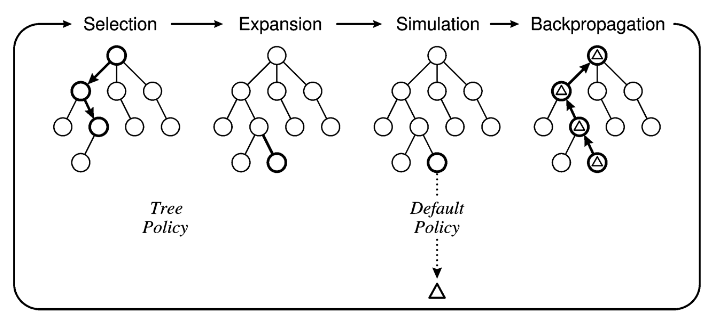
  1. 选择(Selection):从根节点开始,根据某种策略(如UCB1公式),选择一条路径直到达到一个未扩展的节点。
  2. 拓展(Expansion):在当前选中的节点上添加一个新的子节点。
  3. 模拟(Simulation):从新扩展的节点开始进行随机模拟(即走子),直到游戏结束,并记录结果。
  4. 反向传播(Backpropagation):将模拟的结果回传,更新沿途节点的统计信息。

值得一提的是,MCTS通过不断重复上述过程,逐渐构建出一个代表不同行动及其结果概率的搜索树。最终,算法会选择具有最高胜率的行动作为推荐的行动。

此外,MCTS与传统的博弈树搜索相比,它不需要构建整个博弈树,而是通过模拟来评估局面,这使得它能够处理更大规模的搜索空间。然而,MCTS也存在一些局限性,比如对于非零和游戏的适应性、在面对随机性或不完全信息时的表现等问题。尽管如此,MCTS仍然是现代人工智能领域的一个重要工具,尤其是在棋类游戏中的应用,如AlphaGo/Zero等著名程序就是基于MCTS的变体。

Background

包含决策过程(decision theory)、博弈论(game theory)、Monte Carlo 以及 bandit-based methods。

Decision Theory

本质是马尔可夫决策决策过程(Markov Decision Processes,简记为 MDPs),通过一系列 状态-动作-回报 系列完成对于决策过程的刻画。

部分观测的MDP(Partially Observable MDPs,简记为POMDP),每次获得的状态只是整体状态的一部。

Game Theory

Monte Carlo Methods

Bandit-Based Methods

多臂老虎机问题(Multi-armed Bandit problems)是知名的系列决策问题。该问题的难点在于平衡探索与开发(Exploration and Exploitation),以推荐系统为例,在已经知道用户兴趣点之后需要进行“开发”,但是现有的兴趣点可能不是用户最感兴趣的,或者该兴趣点会随着时间改变,因此需要进行“探索”,不断试探用户新的感兴趣内容。在Spin Glass求基态问题中,表现为是在这个结构中继续降低能量,还是选择升高温度跳出当前局域范围进行探索。Bandit 算法用于解决该问题。

一种有效的方案是基于上置信界(upper confidence bound 简记UCB)。最简单的UCB算法为UCB1

细致平衡和这个感觉类似,这两者是否有关系?

Monte Carlo Tree Search

MCTS依靠于两个基本概念:动作的真实回报,可以依靠随机模拟近似;这些回报可以有效的调整策略去接近最优策略。

Algorithm

基础算法通过迭代构建树,从根节点出发搜索子节点,然后选取最好的子节点作为下一次搜索的根节点。在这个迭代过程中有4个典型步骤: 1) 选择:从根节点开始递归应用子节点选择策略遍历整个树,直到达到收敛节点。 2) 探索:产生动作,将更多节点添加进树中。 3) 模拟评估:通过策略模拟给出一个节点的评估分数。 4) 反向传播:通树结构反向传播模拟评估结果。

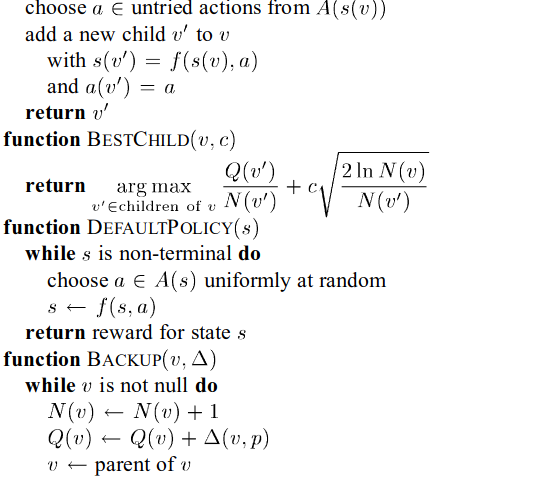
采用以下两个直接的策略: 1) Tree policy: 从搜索树中选择或者探索一个叶子节点。如何平衡探索与贪心选择,是这个算法的关键。 2) Default policy: 模拟评估非终止状态的分数。这里一直没有明白,算法并没有对该模型的知识,如何评估一个局面的好坏呢?如果已经对这个问题已经有了很好的了解,那直接贪心就可以了,为什么还要有MCTS?

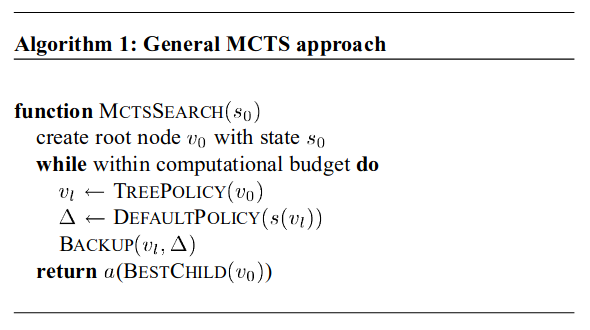
伪代码为: Algorithm

v0是根节点s0的评分,其中vl是叶子节点sl的评分,Δ是从探索节点返回的值。

general MCTS approach

上面展示了一次过程的示意图。

Development

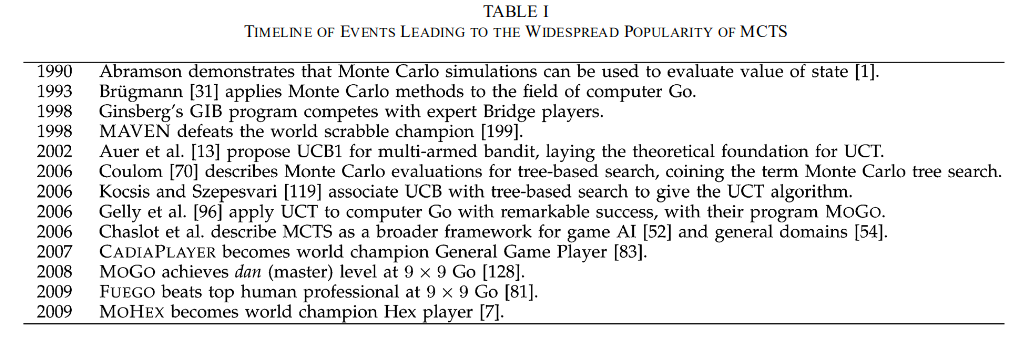
development of MCTS

Tree policy

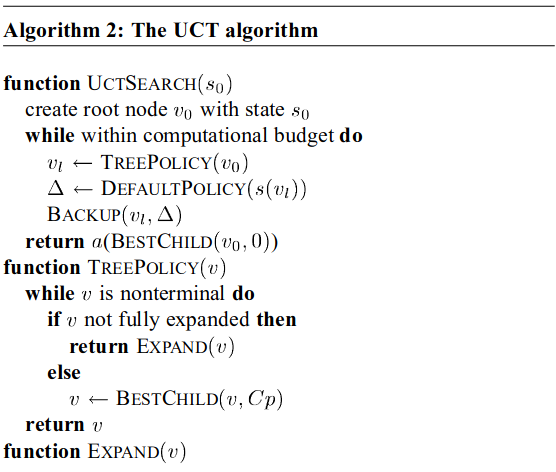
Upper Confidence Bound for Trees (UCT)算法是Tree policy中的一种,用于解决exploration–exploitation dilemma.

在子节点j去选择最大化: $$\begin{align} \mathrm{UCT}=\bar{X}_j+2 C_p \sqrt{\frac{2 \ln n}{n_j}} \label{UCB} \end{align}$$

其中 n 是当前节点被遍历过的次数,nj是子节点j被遍历过的次数,并且限制Cp > 0。如果超过一个子节点有相同的最大值,通常随机选择。Xi, tj是选择j的平均回报,值在范围[0, 1]上。通常设置nj = 0用于鼓励探索未曾探索过的区域。Cp可以用来调节探索的倾向,有很多文献对这个的选择有很多讨论。

$\eqref{UCB}$存在这样的一种思想,如果子节点都探索过,倾向于选择收益高的节点;如果子节点存在没有探索过的节点,倾向于选择没有探索过的节点。

Default policy

In the simplest case, this default policy is uniformly random.

最简单的处理方案是随机产生。

看这部分算法原本目的是想要了解这部分内容,但是现在发现MCTS的核心思想在于如何平衡探索和开发。这部分策略本质上是评价函数,如何构建评价函数,从而可以对状态进行评分。这其实是强化学习的任务。MCTS的任务是在知道这部分内容的前提下,将评估函数很好的与实际应用结合。

该函数的设计本质上是一个很难的问题。综述中给出了如下的设计提升方案: * Rule-Based Simulation Policy * Contextual Monte Carlo Search * Fill the Board * Learning a Simulation Policy * Using History Heuristics * Evaluation Function * Simulation Balancing * Last Good Reply * Patterns

Code

UCB UCB 以上式算法的伪代码。

下面分析GitHub上关于MCTS的实现,代码地址

首先导入相关的包:

1
2
3
4
5
6
7
8
import logging
import math

import numpy as np

EPS = 1e-8

log = logging.getLogger(__name__)

接下来创建名为MCTS的类:

1
2
3
4
5
6
7
8
9
10
11
12
13
14
15
16
17
18
19
20
21
22
23
class MCTS():
"""
This class handles the MCTS tree.
"""

def __init__(self, game, nnet, args):
self.game = game
self.nnet = nnet
self.args = args
# 以下内容全部用字典表示,key是状态对应的字符串
# 存储状态的Q值
self.Qsa = {} # stores Q values for s,a (as defined in the paper)
# 存储已经探索过状态-动作对的次数
self.Nsa = {} # stores #times edge s,a was visited
# 存储已经探索过状态的次数
self.Ns = {} # stores #times board s was visited
# 存储初始策略
self.Ps = {} # stores initial policy (returned by neural net)

# 存储游戏终止状态
self.Es = {} # stores game.getGameEnded ended for board s
# 存储该状态下接下来合法移动
self.Vs = {} # stores game.getValidMoves for board s

以下searchgetActionProb函数,均是MCTS类中的函数。

search函数执行一次搜索过程,从一个节点开始,不断探索子节点,直到达到终态。每一步选择最大UCB的过程。

1
2
3
4
5
6
7
8
9
10
11
12
13
14
15
16
17
18
19
20
21
22
23
24
25
26
27
28
29
30
31
32
33
34
35
36
37
38
39
40
41
42
43
44
45
46
47
48
49
50
51
52
53
54
55
56
57
58
59
60
61
62
63
64
65
66
67
68
69
70
71
72
73
74
75
76
77
78
79
80
81
82
83
84
85
86
87
88
89
90
91
92
93
94
95
96
97
98
99
100
101
102
class MCTS():
def __init__(self, game, nnet, args):
...

def search(self, canonicalBoard):
"""
This function performs one iteration of MCTS. It is recursively called
till a leaf node is found. The action chosen at each node is one that
has the maximum upper confidence bound as in the paper.

Once a leaf node is found, the neural network is called to return an
initial policy P and a value v for the state. This value is propagated
up the search path. In case the leaf node is a terminal state, the
outcome is propagated up the search path. The values of Ns, Nsa, Qsa are
updated.

NOTE: the return values are the negative of the value of the current
state. This is done since v is in [-1,1] and if v is the value of a
state for the current player, then its value is -v for the other player.

Returns:
v: the negative of the value of the current canonicalBoard
"""

# 将状态转化为字符串的形式
s = self.game.stringRepresentation(canonicalBoard)

# 如果状态不在之前是否记录表中,则重新检测是否为终态。
if s not in self.Es:
# 是终态返回 1 or -1(表示胜负结果),不是终态返回 0
self.Es[s] = self.game.getGameEnded(canonicalBoard, 1)

# 如果已经终止,直接返回结果
if self.Es[s] != 0:
# terminal node
return -self.Es[s]

# 如果不在策略的记录表中,产生初始策略
if s not in self.Ps:
# leaf node
# 神经网络评估该状态价值
self.Ps[s], v = self.nnet.predict(canonicalBoard)
# 产生所有合法移动
valids = self.game.getValidMoves(canonicalBoard, 1)
# 遮盖不合法移动
self.Ps[s] = self.Ps[s] * valids # masking invalid moves
sum_Ps_s = np.sum(self.Ps[s])
if sum_Ps_s > 0:
self.Ps[s] /= sum_Ps_s # renormalize
else:
# if all valid moves were masked make all valid moves equally probable

# NB! All valid moves may be masked if either your NNet architecture is insufficient or you've get overfitting or something else.
# If you have got dozens or hundreds of these messages you should pay attention to your NNet and/or training process.
log.error("All valid moves were masked, doing a workaround.")
self.Ps[s] = self.Ps[s] + valids
self.Ps[s] /= np.sum(self.Ps[s])

self.Vs[s] = valids
self.Ns[s] = 0
return -v

# 给予当前状态的合法移动
valids = self.Vs[s]
# 初始化当前最好UCB,当前最好选择
cur_best = -float('inf')
best_act = -1

# pick the action with the highest upper confidence bound
# 选择UCB最高的动作,返回所有可能的动作状态数
for a in range(self.game.getActionSize()):
if valids[a]: #检测是否合法
# 计算UCB
if (s, a) in self.Qsa:
u = self.Qsa[(s, a)] + self.args.cpuct * self.Ps[s][a] * math.sqrt(self.Ns[s]) / (
1 + self.Nsa[(s, a)])
else:
u = self.args.cpuct * self.Ps[s][a] * math.sqrt(self.Ns[s] + EPS) # Q = 0 ?

if u > cur_best:
cur_best = u
best_act = a

# 选择子节点并更新状态
a = best_act
next_s, next_player = self.game.getNextState(canonicalBoard, 1, a)
next_s = self.game.getCanonicalForm(next_s, next_player)

# 子节点进行迭代
v = self.search(next_s)

# 更新X与Nsa
if (s, a) in self.Qsa:
self.Qsa[(s, a)] = (self.Nsa[(s, a)] * self.Qsa[(s, a)] + v) / (self.Nsa[(s, a)] + 1)
self.Nsa[(s, a)] += 1

else:
self.Qsa[(s, a)] = v
self.Nsa[(s, a)] = 1

self.Ns[s] += 1
return -v

getActionProb为MCTS的每一步搜索

1
2
3
4
5
6
7
8
9
10
11
12
13
14
15
16
17
18
19
20
21
22
23
24
25
26
27
28
29
30
31
32
33
34
35
36
37
class MCTS():
def __init__(self, game, nnet, args):
...

# 温度相当于给予不同动作一个概率,如果temp=1则直接贪心选择
def getActionProb(self, canonicalBoard, temp=1):
"""
This function performs numMCTSSims simulations of MCTS starting from
canonicalBoard.

Returns:
probs: a policy vector where the probability of the ith action is
proportional to Nsa[(s,a)]**(1./temp)
"""
# 进行多次模拟
for i in range(self.args.numMCTSSims):
self.search(canonicalBoard)

# 将状态编码为字符串
s = self.game.stringRepresentation(canonicalBoard)

# 遍历当前状态下,所有合法动作已经探索过的次数
counts = [self.Nsa[(s, a)] if (s, a) in self.Nsa else 0 for a in range(self.game.getActionSize())]

# 如果温度为0则贪心的返回
if temp == 0:
bestAs = np.array(np.argwhere(counts == np.max(counts))).flatten()
bestA = np.random.choice(bestAs)
probs = [0] * len(counts)
probs[bestA] = 1
return probs

# 温度非0,给予每个动作一个归一化的被选择几率值
counts = [x ** (1. / temp) for x in counts]
counts_sum = float(sum(counts))
probs = [x / counts_sum for x in counts]
return probs